
The Moment You Notice Something Is Wrong
It usually happens on an ordinary morning. You hit the button, and instead of gliding up smoothly, the door jerks to one side, grinds against metal, or stalls halfway with a sound like a shopping cart wheel. Maybe you walk over and see daylight between a roller and the track where there shouldn't be any. Maybe the door looks slightly crooked when it's open, like one side got there before the other. None of that is normal, and it rarely fixes itself. It usually gets louder and worse over the following weeks.
Symptoms That Point to a Track Problem
- The door drags, jerks, or hesitates on one side as it travels, instead of moving evenly on both tracks.
- Grinding, scraping, or popping noises that seem to come from one side of the door rather than the opener or springs.
- The door reverses on its own partway through closing, especially if your opener has auto-reverse safety sensors that read the binding as an obstruction.
- A visible gap between a roller and the track, or a track that visibly bows outward or inward instead of running in a straight, parallel line.
- The door looks crooked or tilted when fully open, with one corner sitting lower than the other.
- Panels appear to bow or pull away from the track on one side, especially near the bottom section.
Any one of these on its own is worth investigating. Several together usually mean the misalignment has been building for a while.
What a Technician Checks, in Order
1. Visual Alignment of the Tracks
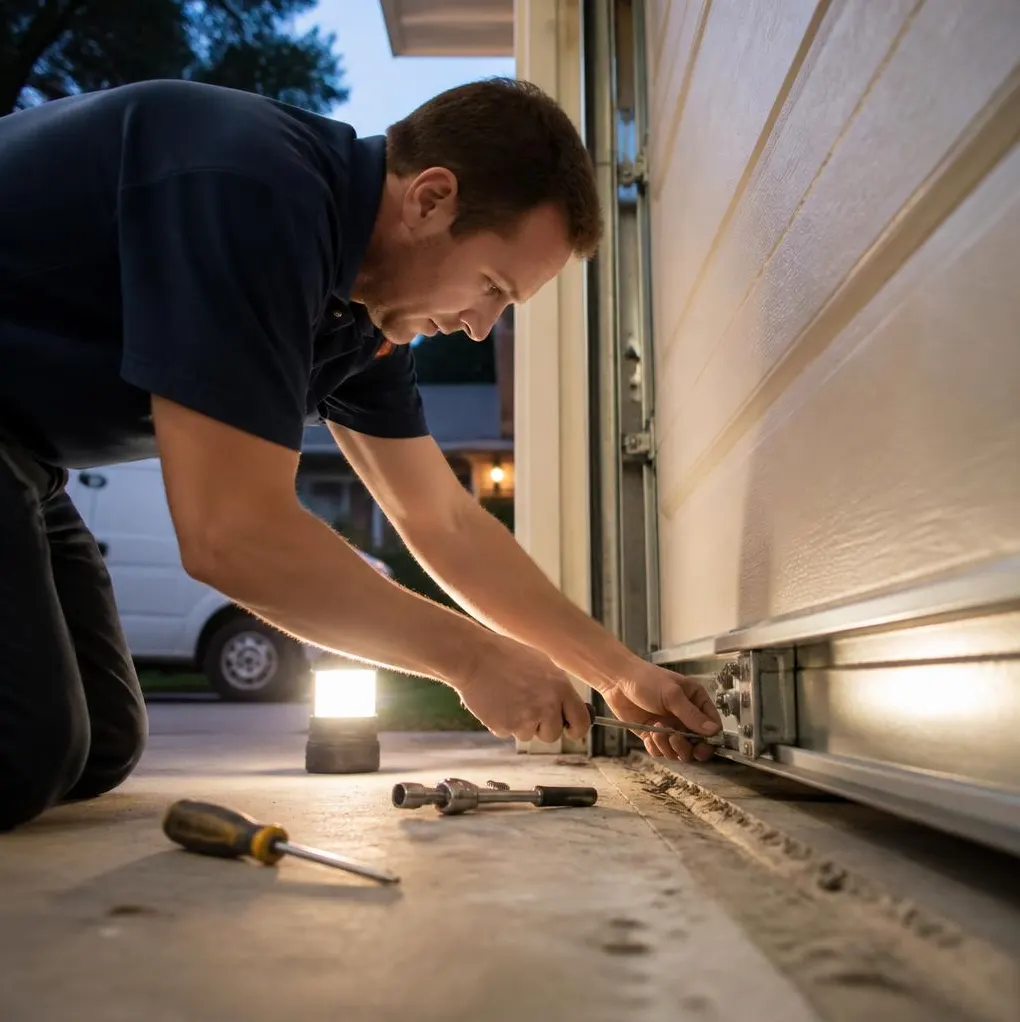
The first thing a technician does is sight down each track from top to bottom, checking that it runs straight and that both sides are parallel and level with each other. A single dent or bend is often the result of impact: a car bumper, a bike, a basketball backboard arm swinging too close, or a ladder leaned against the wrong spot. If the bend is minor, the track can sometimes be carefully straightened in place. If it's sharp or has stressed the metal, the damaged section gets replaced rather than bent back, since a repeatedly flexed track tends to fail again at the same spot.
2. Mounting Brackets and Hardware
Next comes every bracket holding the track to the frame. Garage doors cycle up and down thousands of times a year, and that vibration gradually loosens bolts and lag screws. In this part of Georgia, humidity and summer storm moisture also speed up rust on exposed hardware, which weakens the grip brackets have on wood framing. The fix here is straightforward: retighten or replace hardware, and swap any corroded brackets for new ones. It's a cheap fix if caught early, and a common one after a few years of heavy use.
3. Rollers
Worn, cracked, or flat-spotted rollers are checked next, since a roller that no longer rolls smoothly can walk the door sideways out of the track over time, especially nylon rollers that have dried out or plastic rollers nearing the end of their life. Replacing a full set of rollers is routine work and often prevents future track issues rather than just reacting to this one.
4. The Framing the Track Is Bolted To
This step matters more here than in drier climates. Heavy rain, humidity, and the pine framing common around garages in this area can swell, warp, or soften over time, especially if water has been running down the jamb or pooling near the base. A perfectly straight track bolted to framing that has shifted or rotted will still look misaligned, because the whole mounting surface moved. The fix may involve reinforcing or replacing a section of framing before the track is reattached, not just adjusting the track itself.
5. Panel Damage
Sometimes the track isn't the real problem. A dented or bowed panel, especially the bottom section, can throw off the whole door's geometry and make an otherwise fine track look like it's fighting the door. A technician checks panel squareness before doing any more track work, since straightening a track to match a bent panel just creates a new set of problems.
6. Opener Force and Limit Settings
Last, the opener itself gets checked. If the down-force or limit settings are too aggressive, the opener can keep pulling or pushing the door even when it meets resistance, slowly racking the door frame out of true. Adjusting these settings is part of fixing the root cause, not just the symptom.
Why This Isn't a DIY Repair
Garage door tracks work under spring tension, and torsion or extension springs store enough force to cause serious injury if a track shifts while someone is working near it. Bending a track back by hand, loosening the wrong bracket, or working near a door that's partially off-track is one of the more common ways people get hurt in their own garage. This is a job for someone with the right clamps, bar, and experience reading how the door will move once a bracket is loosened.
When to Call Braselton Garage Door
If your door is grinding, pulling to one side, or reversing when it shouldn't, it's time to call rather than keep running it. Braselton Garage Door handles both the diagnosis and the fix through our Garage Door Repair service, checking track alignment, rollers, brackets, and framing in the order outlined above, and we also offer Preventive Maintenance visits that catch loose hardware and early wear before they turn into a bent track or an off-track door in the first place.
If you're in Braselton, Hoschton, Jefferson, Winder, Flowery Branch, Buford, Dacula, or Auburn and your garage door is grinding, sticking, or sitting crooked in the opening, give Braselton Garage Door a call. We'll get it running straight and quiet again, and tell you honestly whether it's a quick fix or something bigger before we start.